Choosing the right dust extraction filter isn’t just about ticking a compliance box — the wrong system can mean poor capture efficiency, high running costs, frequent downtime, or a unit that simply can’t keep pace with your production. With so many filter types on the market, it helps to understand what separates them before comparing specific products.
This guide explains the main types of industrial dust extraction filter, the key factors that should drive your choice, and how the Air Plants range — Cyclofilter, Modulair, Multiair, Transair, Multi-Sleeve and Jet Air Cartridge — compares, so you can identify the right fit for your factory or workshop.
Bag filters, also known as sleeve filters, draw dust-laden air through fabric sleeves that trap particulate while allowing clean air to pass through. They’re one of the most common and cost-effective solutions for medium-to-large volume extraction and are well suited to a wide range of dust types, including wood dust. Performance relies heavily on a primary dust ‘cake’ building up on the sleeve surface, so correct filtration velocity — matched to the specific application — is essential to maintain efficiency and filter life.
Cartridge filters use pleated filter media, which offers a much larger filtration surface area within a smaller footprint than an equivalent bag filter. This makes them particularly effective for fine or high-grade dust particles, often achieving very high capture efficiencies even at sub-micron particle sizes.
Cyclone-style systems use centrifugal force to separate larger, heavier dust particles from the airstream before it reaches the final filter stage. This reduces the load on the filter media and is particularly effective where high volumes of waste material are being generated, as well as for continuous operation.
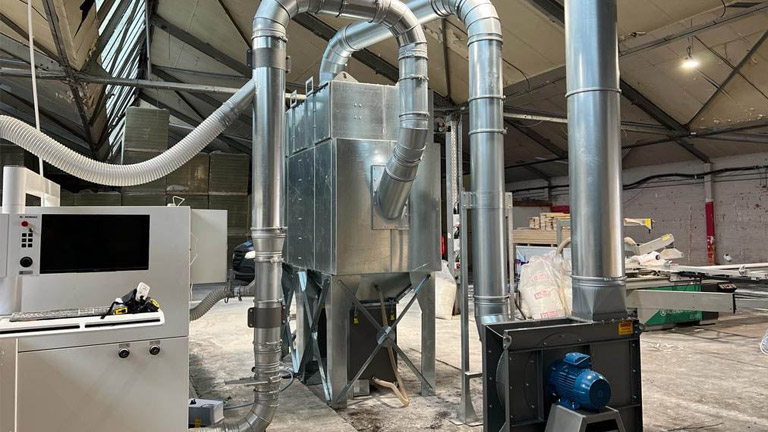
Smaller, self-contained sleeve-filter units are designed for single machines or small workshops rather than whole-site extraction, offering a compact and cost-effective solution for intermittent use.
Air Plants manufactures a full range of dust extraction filters in the UK, each engineered for a different combination of the factors above. Here’s how they compare:
Product | Best suited to | Operation type | Typical particle size | Key characteristic |
Cyclofilter | High waste volumes, continuous operation, medium-to-large sites | Continuous, 24-hour operation | 5µm to 20mm | Cyclonic pre-separation; low pressure drop; 10,000–100,000+ m³/h; flat or cone-bottom discharge |
Modulair Bag Dust Collector | Medium-to-large single-shift workplaces | Single shift / intermittent | 5µm to 20mm | Modular, 60m²–400m²+ filtration area; reparative (kick-pulse) cleaning on shutdown |
Multiair Bag Dust Collector | Medium-to-large sites, including multi-fan systems | Continuous, up to 24 hours | 5µm to 20mm | AFT range; on-demand reverse jet cleaning |
Transair Bag Dust Collector | Sites wanting lower running costs, continuous operation | Continuous | 5µm to 20mm | ECO range; airflow resistance <250Pa; smaller fan motors |
Multi-Sleeve Dust Unit | Small-to-medium workshops, single/few machines | Intermittent use | 5µm to 20mm | Up to 45 sleeves; compact; six sizes available |
Jet Air Cartridge Dust Collector | Fine, high-grade dust requiring a compact footprint | Continuous | Sub-micron to fine (99.996% efficiency @ 0.5 micron) | Modular cartridge media; compact footprint; 100m² filter media area per module |
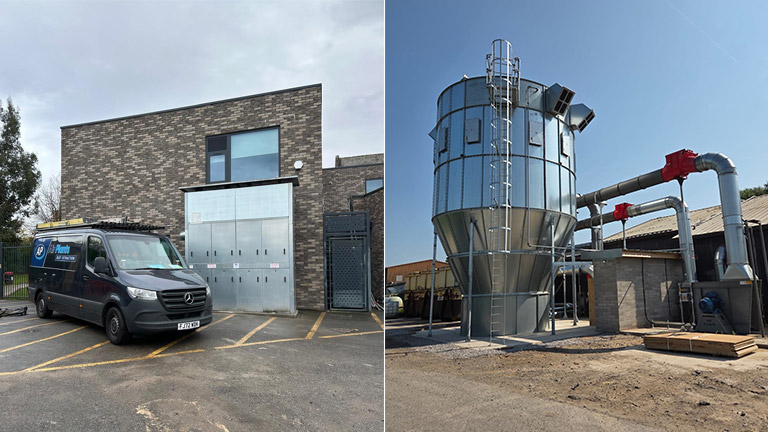
Part of the Advanced Filter Technology (AFT) range, the Cyclofilter is built for continuous, up-to-24-hour operation and high volumes of waste material, with air volumes from 10,000m³/h up to 100,000m³/h and beyond. Cyclonic pre-separation removes larger, heavier particles before the airstream reaches the filter media, reducing filter loading and helping to maintain a low pressure drop across the system. An automatic reverse jet cleaning system maintains a constant pressure drop across the filter media, and units are available in flat-bottom or cone-bottom discharge, constructed from galvanised carbon steel with an optional paint finish. It’s a strong choice for medium-to-large sites generating high waste volumes that can’t afford downtime for filter cleaning.
Also part of the modular ECO range, the Modulair is designed for medium-to-large dust extraction applications on a single shift pattern. It handles particles from 5µm to 20mm, with filtration areas from 60m² up to 400m²+ depending on the model, resistance to airflow of less than 250Pa, and reparative (kick-pulse) cleaning triggered on shutdown, rather than cleaning during operation. Its ATEX-compliant construction makes it a strong fit for wood-processing sites needing dependable, cost-effective daily-shift extraction.
The Multiair is built for medium-to-large applications requiring continuous operation, and can be configured across multiple fans where required. It handles the same 5µm to 20mm particle range as the Modulair, with an on-demand reverse jet cleaning system controlled by a differential pressure controller, antistatic filter sleeves for effective ‘cake’ release, and a heavy-duty screw conveyor for controlled waste removal.
Part of the ECO range, the Transair is engineered for efficiency and lower running costs during continuous operation, with airflow resistance of less than 250Pa allowing smaller fan motors to be specified. Its non-blocking filter sleeve arrangement and steel inlet guards protect the filter media from degradation by larger chips — a useful feature for busy woodworking environments — extending filter life and maintaining system efficiency.
Designed for intermittent use, the Multi-Sleeve unit connects easily to individual machines such as sanders, bandsaws, circular saws, planers and CNC machines, making it a popular choice for smaller joinery workshops. Available with up to 45 sleeves depending on the model, across six sizes, it offers a compact, dynamically balanced (G2.5 standard) solution with EFF3 ATEX-rated motors as standard.
For fine and high-grade dust particles, the Jet Air Cartridge Dust Collector delivers high-efficiency filtration of 99.996%, with dust carry-over as low as 5-10mg/m³ at 0.5 micron. Its modular cartridge design offers up to 100m² of filter media per module in a compact footprint, with a pressure differential pulse controller and Integrated Primary Separation (IPS) for efficient, low-maintenance operation. It’s well suited to applications generating fine, high-grade dust — including fine wood dusts such as MDF sanding dust — as well as other industrial applications such as printing, pharmaceutical and automotive processes.
Wood dust presents a specific combination of challenges: high volume, variable particle size (from fine MDF sanding dust to coarse sawdust and chips), and combustibility. For most joinery and furniture manufacturing sites, this points toward the Modulair, Multiair or Transair bag filter ranges — all rated for the 5µm to 20mm particle range typical of wood dust, ATEX-compliant, and available with the screw conveyor and discharge options needed for high-volume waste removal. Smaller workshops with individual machines are often better served by a Multi-Sleeve unit, while larger sites generating high volumes of waste may need the cyclonic pre-separation of a Cyclofilter. As with any dust extraction system, the right choice ultimately comes down to getting a system correctly sized and specified for your site’s specific requirements — rather than a single product being universally ‘best’.
The right filter for your factory depends on your specific dust type, volume, operating pattern and site layout — which is exactly why a proper system design, rather than a generic product choice, matters. Air Plants has been designing and manufacturing dust extraction systems in the UK since 1897, with over 50,000 installations nationwide, and offers a free, no-obligation on-site survey to specify the right filter for your application.